

New Zealand has the renewable energy, growing investment interest and ambition to become a serious player in the global AI economy. But what will it take to turn that potential into infrastructure that delivers lasting value?
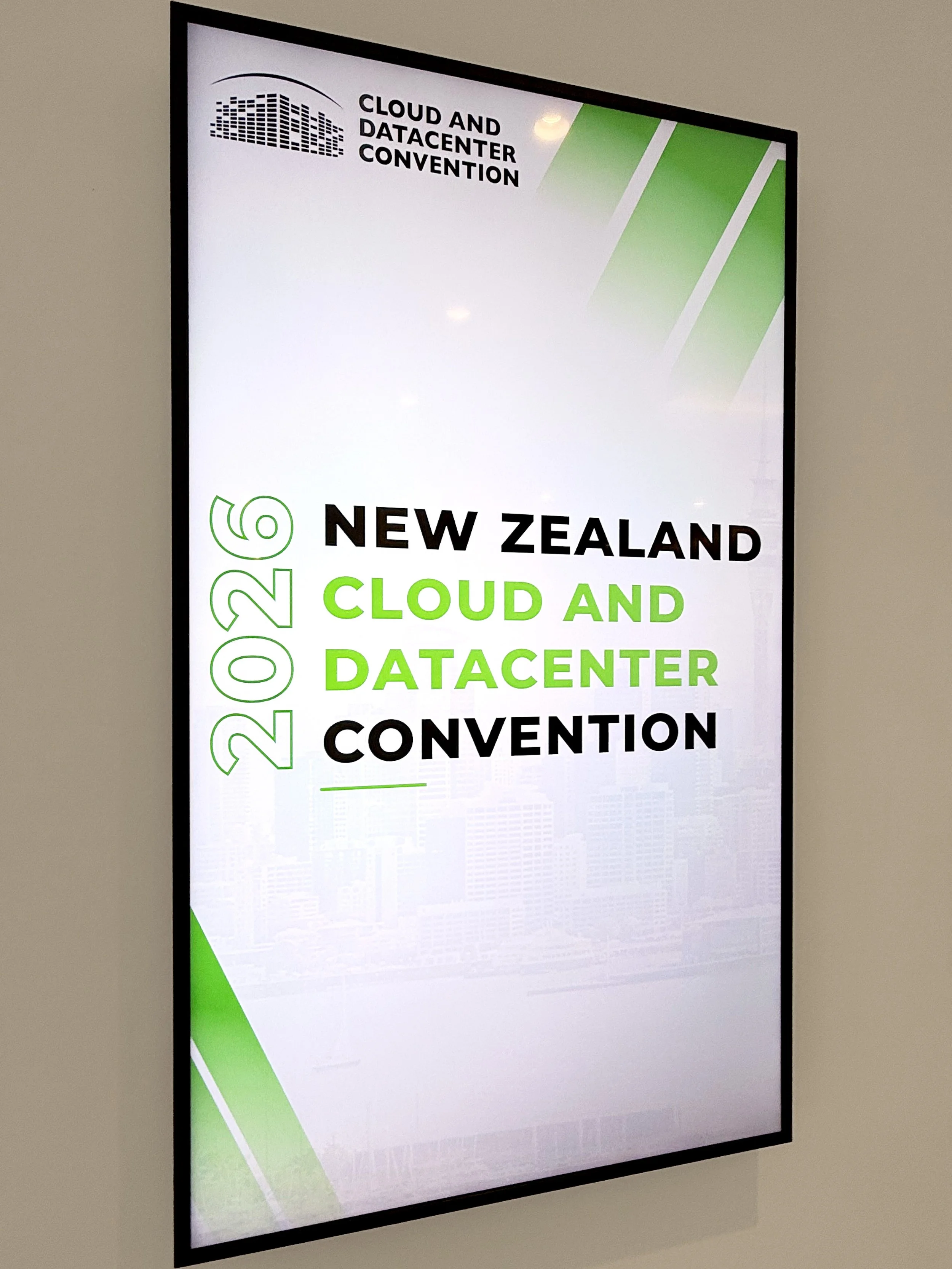
At the New Zealand Cloud & Datacenter Convention in Auckland on 5 November 2026, one of the most interesting questions wasn't simply how many more data centres New Zealand could build.
It was what the country could gain from building them.
With artificial intelligence driving demand for computing capacity worldwide, New Zealand is being considered for a role that extends beyond supporting its own digital economy.
Could the country become an exporter of AI computing services, attracting international customers to infrastructure powered largely by renewable electricity?
And if that opportunity exists, what needs to happen to make it a reality?
Cemac Data Centre Solutions was among the exhibitors at this year's convention, where discussions covered everything from international investment and electricity availability to high-density computing, infrastructure delivery and community expectations.
Together, these discussions highlighted an important distinction: attracting investment in data centres is one challenge. Delivering infrastructure that can operate efficiently, reliably and responsibly is another.
From Hosting Data to Exporting Computing Power
For many years, New Zealand's data centre requirements have largely been viewed through the lens of domestic demand, supporting businesses, government services, telecommunications and cloud computing.
AI is opening the possibility of a much larger market.
Rather than simply providing a location to store or process New Zealand's own data, the country could potentially supply computing capacity to customers overseas.
This was a central theme of the convention.
Vic Rose, CEO of Meridian Cloud, delivered a keynote exploring whether New Zealand could become a regional digital infrastructure hub. Rémi Galasso, founder and CEO of Datagrid, examined the opportunity for New Zealand to compete internationally as a destination for clean AI computing.
The distinction matters economically.
A data centre can create value through construction, infrastructure investment and ongoing operations. But providing computing services to international customers could create further opportunities for local businesses, technical specialists and the wider digital economy.
New Zealand would not simply be accommodating global demand. It could participate in supplying the computing services behind it.
That ambition is already reflected in the New Zealand Data Centre Strategy, released by DataCentres New Zealand in August 2026.
The industry-led strategy identifies two connected priorities: developing the domestic infrastructure needed to strengthen New Zealand's digital capabilities, and creating a sustainable export opportunity through international investment in data centres and AI infrastructure.
It represents an important shift in how the sector sees its future.
The Economic Opportunity Is Significant
The potential scale of this opportunity is becoming clearer.
In August 2026, Boston Consulting Group (BCG) published its report, New Zealand: A Destination for Data, examining the economic potential of expanding the country's data centre capacity.
The report modelled a scenario in which New Zealand develops more than 1 gigawatt (GW) of new computing capacity over five years.
Under that scenario, BCG estimated the potential for:
NZ$25–35 billion in locally retained private investment in data centres and supporting energy and fibre infrastructure.
Up to 3,500 jobs at peak construction.
Approximately 1,200 ongoing operational jobs once construction is complete.
These are modelled opportunities, not confirmed investments or guaranteed employment outcomes. Realising them would depend on projects proceeding and the wider infrastructure, workforce and policy conditions required to support development.
Nevertheless, the estimates illustrate why data centres are increasingly being discussed as an economic development opportunity, rather than simply another category of commercial construction.
The benefits could extend to engineering, specialist manufacturing, construction, electrical services, telecommunications, equipment supply and ongoing facility maintenance.
For New Zealand businesses working within these sectors, the opportunity is not necessarily limited to the initial construction programme.
The more important question is how much of the long-term value can be retained within New Zealand.




Renewable Energy Is an Advantage, Not a Complete Solution
One of New Zealand's strongest competitive advantages is its electricity generation profile.
According to the Ministry of Business, Innovation and Employment (MBIE), 88.5% of New Zealand's electricity generation came from renewable sources in 2025.
Hydroelectricity, geothermal generation, wind and growing solar capacity provide a potentially attractive foundation for companies seeking to reduce the environmental impact of their computing operations.
New Zealand's relatively temperate climate may also offer opportunities to reduce mechanical cooling requirements, depending on a facility's location, design and operating conditions.
But having a highly renewable national electricity system does not mean unlimited electricity is available wherever a data centre developer chooses to build.
Large facilities require substantial, reliable power supplies. Their feasibility depends on available generation, transmission and distribution infrastructure, connection costs, development timelines and the ability to meet future demand.
These considerations become increasingly significant as computing requirements grow.
The International Energy Agency's (IEA) 2026 analysis projects that global data centre electricity consumption could almost double, from approximately 485 terawatt-hours in 2025 to 950 terawatt-hours by 2030.
The IEA also identifies electricity access, grid connections, equipment supply chains and financing as potential constraints on development.
This creates an important challenge for New Zealand.
Can the country attract significant new computing demand while ensuring that electricity infrastructure develops in a way that supports households, existing industries and future economic growth?
The answer will depend on more than the availability of renewable generation. It will require coordination between developers, electricity providers, network operators, government and the wider infrastructure sector.

The Challenge of Turning Proposed Capacity Into Deliverable Projects
One of the convention's panel discussions asked a particularly relevant question:
Where will New Zealand's next 200MW of data centre demand come from, and what will it take to deliver it?
The 200MW figure framed a discussion about future demand. It should not be interpreted as confirmed new capacity.
The panel explored the difference between identifying an attractive development opportunity and establishing whether a project is genuinely deliverable.
Suitable land is only one consideration.
Electricity capacity, connectivity, natural hazards, planning requirements, consenting and construction resources can all influence whether a project proceeds.
These elements also need to align within a realistic development programme.
For example, securing a site before establishing the availability and timing of a suitable electricity connection could introduce significant risk. Similarly, designing a facility without fully considering future equipment and cooling requirements may create expensive challenges later.
This is particularly relevant to hyperscale developments, where the scale of investment and complexity of the infrastructure can make late changes difficult and costly.
The objective is not simply to build more capacity. It is to build capacity that can be delivered, connected and operated successfully.
Southland Offers a Practical Example
Datagrid's proposed AI data centre campus at Makarewa, near Invercargill, demonstrates the range of infrastructure requirements involved in developing a large-scale facility.
The project received resource consent in March 2026, and initial site infrastructure works commenced in August.
The development includes more than the proposed computing facilities. It requires substantial electricity infrastructure, telecommunications connectivity, access roads, cooling systems and supporting services.
In July 2026, Datagrid also announced a supply and installation contract for the planned Tasman Ring Network, a 2,300km submarine cable connecting Invercargill with Melbourne.
The proposed cable would create a direct international connection from New Zealand's South Island, providing an alternative to routes that currently depend on North Island connectivity.
While the project remains under development, it illustrates why data centre investment cannot be considered independently of the infrastructure surrounding it.
A facility's commercial potential depends on its ability to access electricity, connect to customers and operate within the requirements of its location.

AI Is Changing What Data Centre Infrastructure Needs to Deliver
Alongside the economic opportunity, the convention explored how AI is changing the technical requirements of data centres.
A keynote by Schneider Electric examined the power and cooling challenges associated with high-density computing, including the role of advanced air cooling, liquid cooling and infrastructure designed for evolving GPU technologies.
These are significant considerations.
The IEA reports that AI server power density increased elevenfold between 2020 and 2025, with further substantial increases projected.
Higher equipment densities can mean greater power consumption and heat generation within a smaller physical footprint.
This affects much more than the servers themselves.
Cooling systems must remove heat effectively. Power distribution infrastructure must support demanding electrical loads. Structural systems must accommodate equipment and associated services, while allowing appropriate access for maintenance and future modifications.
In air-cooled environments, effective airflow management remains important. Hot and cold aisle containment can help prevent unwanted mixing of supply and exhaust air, improving the effectiveness of cooling systems.
Raised access flooring, where incorporated into the facility design, can support service distribution and underfloor airflow arrangements.
Structural ceiling systems provide an alternative means of supporting overhead services, but require careful coordination with equipment layouts, containment and other building systems.
For New Zealand facilities, seismic engineering introduces further requirements that must be considered alongside operational performance.
As data centres evolve, these supporting systems need to function together rather than being treated as separate components.
This is particularly important when existing facilities are upgraded to accommodate new computing equipment.
An increase in rack density may affect cooling requirements, structural loading, service pathways and maintenance access simultaneously.
The most effective solutions consider these relationships early, allowing potential conflicts to be identified before they become installation or operational problems.
Growth Also Depends on Community Trust
Another significant convention discussion focused on social licence and what responsible data centre development should look like.
Social licence concerns the acceptance and trust a development earns from the communities affected by it, beyond the formal approvals required to proceed.
As facilities become larger and electricity-intensive, questions about resource use, environmental impact and local economic benefits are becoming increasingly relevant.
Communities may reasonably want to understand how a proposed facility will affect electricity infrastructure, water resources, noise levels, employment opportunities and surrounding development.
For the industry, this creates a responsibility to communicate clearly about both potential benefits and impacts.
The DataCentres New Zealand strategy also emphasises the importance of meaningful engagement with communities and mana whenua, alongside transparent and responsible development.
These considerations are not separate from project delivery.
They can influence site selection, design decisions, consenting requirements and the long-term relationship between a facility and its surrounding community.
International investment may bring considerable opportunities, but successful development also requires confidence that projects will deliver benefits locally.
Ultimately, responsible growth means considering the wider impact of infrastructure, not simply its immediate commercial performance.
Building Infrastructure That Is Ready for What Comes Next
The discussions at the 2026 New Zealand Cloud & Datacenter Convention demonstrated how closely the country's digital infrastructure ambitions are connected to broader economic, energy and development questions.
New Zealand has several advantages, including a highly renewable electricity system, growing international interest and opportunities to strengthen regional connectivity.
But realising that potential will require careful coordination across multiple industries.
It will also require data centres capable of adapting to changing technology while maintaining the reliability and efficiency expected of critical infrastructure.
For those involved in the physical delivery of these facilities, that means looking beyond individual products and considering how structural systems, cooling, airflow management and services work together throughout a facility's lifecycle.
At Cemac Data Centre Solutions, this integrated approach is central to our work.
Through our specialist Tate raised access flooring, containment systems, airflow solutions, structural ceilings and engineering services, we support the development and upgrading of data centre infrastructure designed around the practical demands of critical environments.
As New Zealand considers its place in the global AI economy, the opportunity is considerable.
The challenge now is to ensure that the infrastructure supporting that ambition is as well considered as the ambition itself.
Planning a new facility or upgrading existing infrastructure? Explore Cemac Data Centre Solutions and our specialist data centre infrastructure services.