

AI workloads require more power, generate more heat and move far greater volumes of data than conventional computing. As a result, AI data centre design is changing how facilities are powered, cooled, connected and planned for future growth.
For many years, data centre design was based on relatively stable requirements. Enterprise racks operated at manageable power densities, air cooling controlled temperatures, and capacity planning focused heavily on floor space, redundancy and uptime.
AI infrastructure has introduced a different set of demands.
Training and operating large AI models involves dense clusters of processors working together. These systems place significantly greater pressure on electrical, cooling and network infrastructure. Each part of the facility must now be planned around the intended workload and hardware.
Higher Rack Densities Are Changing Facility Design
Rack power density has become one of the most important considerations in AI data centre design.
Traditional facilities were commonly designed for rack densities of around 5 to 10kW. According to ASHRAE’s guidance on AI data centre modernisation, modern AI hardware can exceed the practical thermal limits of conventional air-cooled environments.
Future systems are expected to increase those demands further. NVIDIA is developing an 800V DC power architecture because existing data centre power distribution methods are becoming increasingly difficult to scale. Its future Kyber rack-scale platform is being developed for megawatt-scale power requirements.
Higher rack densities affect much more than the racks themselves. Designers may need to reconsider:
Incoming electrical capacity
Transformers and switchgear
Busway and cable sizing
UPS and battery systems
Power conversion losses
Equipment weight and floor loading
Space for electrical distribution
Fire protection requirements
Future expansion capacity
Increasing compute capacity without upgrading the supporting infrastructure can simply shift the constraint to another part of the facility.
Liquid Cooling Is Becoming Essential
Air cooling remains suitable for many conventional data centre workloads. However, it becomes less practical as rack density and heat output increase.
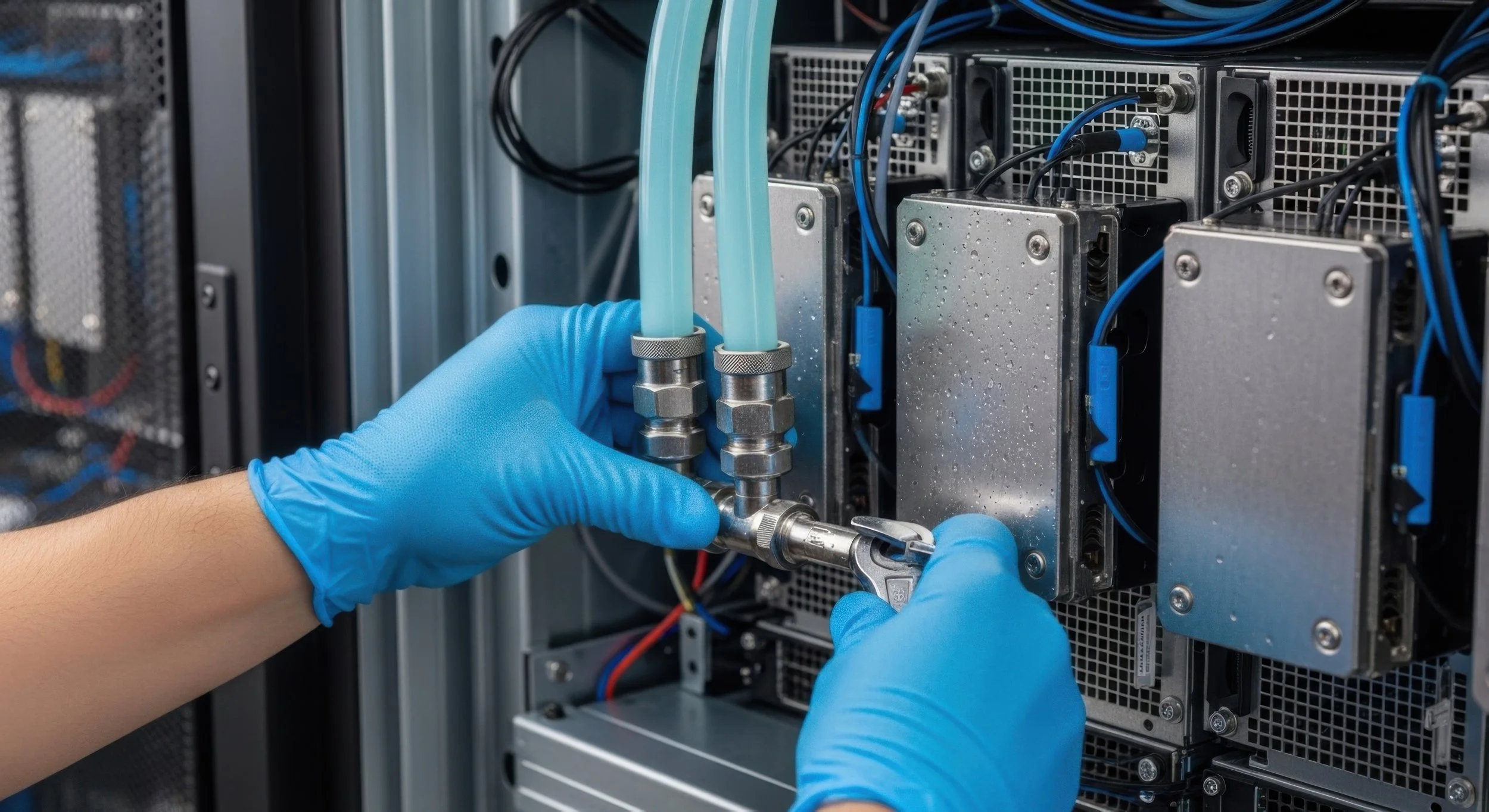
ASHRAE identifies direct-to-chip liquid cooling as a leading solution for high-density AI and high-performance computing environments. Coolant is delivered directly to cold plates attached to processors, removing heat closer to where it is generated.
Other cooling options include rear-door heat exchangers and immersion systems. The right approach depends on the equipment, operating model, density and long-term capacity plan.
Introducing liquid cooling creates additional infrastructure requirements, including:
Coolant distribution units
Facility and technology cooling loops
Pumps, manifolds and heat exchangers
Leak detection and isolation
Fluid monitoring and water treatment
Controls and system monitoring
Maintenance access
Redundancy throughout the cooling system
Many facilities will operate with a hybrid cooling model. Liquid cooling can support the highest-density processors while air cooling continues to serve storage, networking and lower-density equipment.
Cooling therefore needs to be coordinated with the proposed IT equipment early in the design process. Hardware configuration, coolant requirements, operating temperatures and future expansion plans can all influence the final solution.
Power Availability Is Influencing Site Selection
Data centre locations have traditionally been assessed according to connectivity, available land, security, latency and proximity to users. Reliable access to sufficient electricity is now becoming one of the first questions asked.
The International Energy Agency expects global data centre electricity use to increase from approximately 485 terawatt-hours in 2025 to around 950 terawatt-hours by 2030. Electricity consumption from AI-focused facilities is expected to grow considerably faster than the wider data centre sector. The IEA identifies concentrated demand and grid constraints as significant challenges for future development.
Large technology companies are already securing electricity years in advance. Microsoft has entered an agreement supporting the restart of an 835MW nuclear facility in Pennsylvania. Google has signed an agreement with Kairos Power that could enable up to 500MW of advanced nuclear capacity.
These projects demonstrate how closely data centre planning is becoming connected to long-term energy strategy.
For new facilities, power capacity and connection timeframes need to be investigated during site selection. Waiting until the detailed design stage can create delays, redesign work or limits on future capacity.
What AI Data Centre Growth Means For New Zealand
The impact of AI data centres is no longer just an international issue. New Zealand is beginning to consider how much electricity, water and supporting infrastructure these facilities will require.
The proposed Datagrid facility in Southland is expected to require up to 280MW of power, which would make it one of the country’s largest electricity users. RNZ also reports that the project has consent to draw up to 600,000 litres of groundwater per day, although the company says it expects to rely mainly on rainwater.
The scale of projects like this highlights why power availability, cooling efficiency and water use must be considered from the earliest stages of AI data centre design. Local grid capacity, connection timeframes, environmental conditions and opportunities for staged expansion can all influence whether a proposed facility is practical.
Community impact is becoming another important planning consideration. Noise, water use, energy demand and transparency have contributed to opposition against data centre developments overseas. Addressing these matters early can help operators build confidence and reduce the risk of delays later in the project.
For New Zealand, the challenge is to support growing demand for digital infrastructure while ensuring that new facilities are efficient, resilient and appropriate for their location.
Read the RNZ explainer on data centre growth in New Zealand.
AI Networks Have Different Requirements
Traditional enterprise networks handle significant volumes of traffic moving between users and servers. AI training produces a different traffic pattern.
Large numbers of processors exchange data continuously during training. This creates heavy traffic within the compute cluster, making bandwidth, latency and network consistency critical to overall performance.
AI environments are therefore moving towards specialised, high-bandwidth network fabrics using technologies such as InfiniBand, high-speed Ethernet and dedicated accelerator interconnects. NVIDIA’s Spectrum-X platform, for example, has been developed specifically to support large-scale AI workloads over Ethernet.
This also affects the facility’s physical infrastructure. Designers need to consider:
Fibre and cable pathways
Cable management
Equipment positioning
Switch placement
Rack adjacency
Maintenance access
Space for future network expansion
If the network cannot move data efficiently between processors, expensive computing equipment can spend valuable time waiting for information.
Different AI Chips Require Different Infrastructure
NVIDIA is a major supplier of AI accelerators, but data centres are increasingly being built around a wider range of specialised hardware.
Google has developed its Tensor Processing Units, Amazon Web Services offers Trainium, and Microsoft has introduced its Maia accelerators. These systems are designed for different combinations of AI training and inference.
Each hardware platform can have its own requirements for:
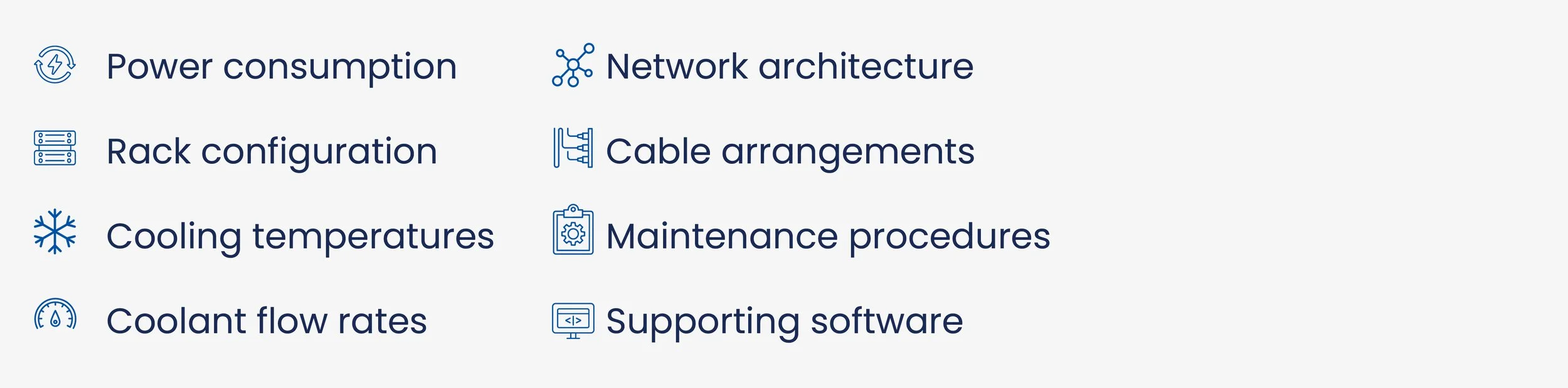
Google describes its AI infrastructure as a coordinated system in which compute, storage, networking, cooling and software are designed to work together. Microsoft has taken a similar approach with Maia, combining silicon, software and data centre infrastructure.
Designing an AI data hall around generic assumptions can create unnecessary risk. The intended equipment and workload should be understood before the physical infrastructure is finalised.
Faster Technology Requires More Flexible Design
AI hardware can develop faster than the facilities built to support it.
A data centre may take years to plan, consent, construct and commission. During that time, expected rack densities, power requirements and cooling methods can change considerably.
Developers are responding with repeatable designs, prefabricated electrical and cooling systems, and modular infrastructure that can be installed in stages. These approaches can reduce work on site and allow capacity to be brought online progressively.
Flexibility can also be built into the facility through:
Space for additional electrical equipment
Scalable power distribution systems
Routes for future liquid cooling pipework
Separate zones for different rack densities
Cooling capacity that can be expanded in stages
Adaptable containment and cable management
Accessible underfloor service routes
Raised access flooring can help provide an organised and adaptable route for power, data and other services. Read our guide to raised access flooring in data centres for more information.
Future-ready design does not require every possible system to be installed immediately. It means ensuring that foreseeable changes can be made without extensive disruption or reconstruction.
Sustainability Starts With The Design
Higher-density computing is increasing scrutiny of both electricity and water use.
Cooling systems involve trade-offs. Some evaporative systems reduce electricity consumption but require more water. Closed-loop systems can significantly reduce ongoing water use, although their total environmental performance still depends on how heat is rejected and where the facility is located.
Microsoft says its newer AI-optimised data centre design uses a closed-loop cooling system that does not continuously consume water through evaporation. Google is also using direct-to-chip cooling alongside site-specific water management programmes.
Energy efficiency, water availability, climate and opportunities for heat reuse should be assessed together. The best solution will depend on the facility, location and intended workload.
“The building, hardware and supporting infrastructure must be planned as one connected environment.”
AI Data Centre Design Requires Early Coordination
The building, hardware and supporting infrastructure must now be planned as one connected environment.
Processors, networking, power distribution and cooling systems directly affect one another. A decision made in one area can influence the capacity, efficiency and resilience of the entire facility.
For new developments and major upgrades, early coordination is essential. The intended workload, rack density, hardware roadmap, cooling strategy, power supply and physical infrastructure should be considered before the detailed design is locked in.
The objective is to create a facility that supports current requirements while remaining adaptable as AI technology continues to develop.
Frequently Asked Questions
What Makes An AI Data Centre Different?
AI data centres typically contain dense clusters of accelerators that require more power, produce more heat and exchange more data than conventional enterprise servers. This changes the requirements for electrical distribution, cooling, networking and physical infrastructure.
Do All AI Data Centres Need Liquid Cooling?
Not necessarily. Lower-density AI equipment may still be supported by air or hybrid cooling. However, direct-to-chip liquid cooling is becoming increasingly important for higher-density processors that exceed the practical limits of conventional air cooling.
Can An Existing Data Centre Be Upgraded For AI?
Some existing facilities can be upgraded, but the available power, cooling capacity, floor loading, network infrastructure and service routes must be assessed first. In some cases, these supporting systems may limit the amount or type of AI equipment that can be installed.
Planning a new data centre or assessing existing infrastructure for higher-density equipment in New Zealand? Contact Cemac Data Centre Solutions to discuss the physical infrastructure requirements of your project.