

Why Airflow Matters More Than Cooling Capacity
When a data centre reaches a thermal limit, the obvious response is often to look at cooling capacity.
Is there enough cooling installed? Does another cooling unit need to be added? Does the chilled-water system need more capacity? Those are important questions, but they do not always identify the real constraint.
A data centre can have sufficient cooling capacity at plant level and still experience hotspots at the rack. The reason is simple: cooling capacity is only useful when that cooling reaches the IT equipment generating the heat. In an air-cooled data centre, conditioned air needs to arrive at server intakes in the right volume and at the right temperature. Hot exhaust air then needs a clear return path that prevents it from mixing back into the supply stream.
Cooling capacity determines how much heat a system can theoretically remove. Airflow determines whether that cooling can be delivered where it is needed.
Cooling capacity and cooling delivery are not the same thing
Almost all of the electrical power consumed by IT equipment ultimately becomes heat. A rack drawing 20 kW therefore creates roughly 20 kW of heat that must be removed. At facility level, it is easy to compare total IT load with the nominal capacity of the cooling plant and conclude that sufficient cooling is available.
But the heat is not distributed evenly through the room. It is concentrated inside servers, storage, networking equipment and other IT hardware. Those systems draw air through their intakes and discharge warmer air through their exhausts.
The cooling system therefore has two jobs: it must have enough capacity to remove the heat, and it must deliver that cooling to the point where the heat is being generated. A facility can solve the first problem without fully solving the second.
The physics shows why airflow matters
For sensible air cooling, heat transfer depends on both airflow and temperature difference. A useful approximation is:
Q (kW) ≈ 1.2 × airflow (m³/s) × ΔT (°C)
So, for example, removing 100 kW of heat with a 12°C temperature rise requires roughly 6.9 m³/s of effective airflow. The exact number will vary with operating conditions, but the principle is important. If the required airflow cannot reach the IT load, spare cooling capacity elsewhere in the facility cannot fully compensate for the distribution problem. The heat and the cooling still need to meet.
Recirculation and bypass can waste available cooling
Two of the most common airflow problems in data centres are recirculation and bypass.
Recirculation occurs when hot exhaust air finds its way back to IT equipment before returning to the cooling system. This can happen through unused rack spaces, gaps around equipment, unsealed cable penetrations or poorly separated hot and cold aisles. The cooling plant may be working correctly, yet the server sees warmer inlet air because exhaust air is mixing back into the supply stream.
Bypass airflow is the opposite problem. Conditioned air returns to the cooling system without first passing through IT equipment.
In both cases, the issue is not necessarily a shortage of cooling. It is that the air is not following the intended path. This is why adding more air does not always solve a hotspot. If the airflow path is wrong, the extra air may simply bypass the equipment or contribute to further mixing.
Cemac’s Airflow Panels & Controls offering is built around this same principle: delivering the right quantity of air directly to equipment and using appropriate panels and controls to minimise bypass.
Containment makes airflow more predictable
Hot-aisle and cold-aisle arrangements are designed to separate supply air from exhaust air. Containment strengthens that separation.
Cold-aisle containment helps keep conditioned air in the intake environment until it passes through the IT equipment. Hot-aisle containment captures warm exhaust air and directs it back towards the cooling infrastructure. Both approaches reduce uncontrolled mixing. That matters because every litre of conditioned air that mixes with hot exhaust before reaching the IT load represents cooling potential that has not been used as intended.
Cemac’s containment solutions are designed for aisle separation in critical environments and form part of a wider infrastructure approach that includes airflow, access flooring and other data centre systems. Containment should therefore be viewed as part of the cooling system, not simply as an enclosure around the racks.
Raised floors and pressure still matter
Where a data centre uses underfloor air distribution, raised access flooring becomes another important part of airflow management. The underfloor void can act as a supply plenum, but having enough total air beneath the floor does not guarantee that every rack receives the correct amount.
Air follows pressure differences and paths of lower resistance. Cabling, pipework, structural elements and other obstructions can alter pressure conditions beneath the floor. One grille or airflow panel may receive more air than required while another receives too little.
That means airflow should be considered as a complete path:
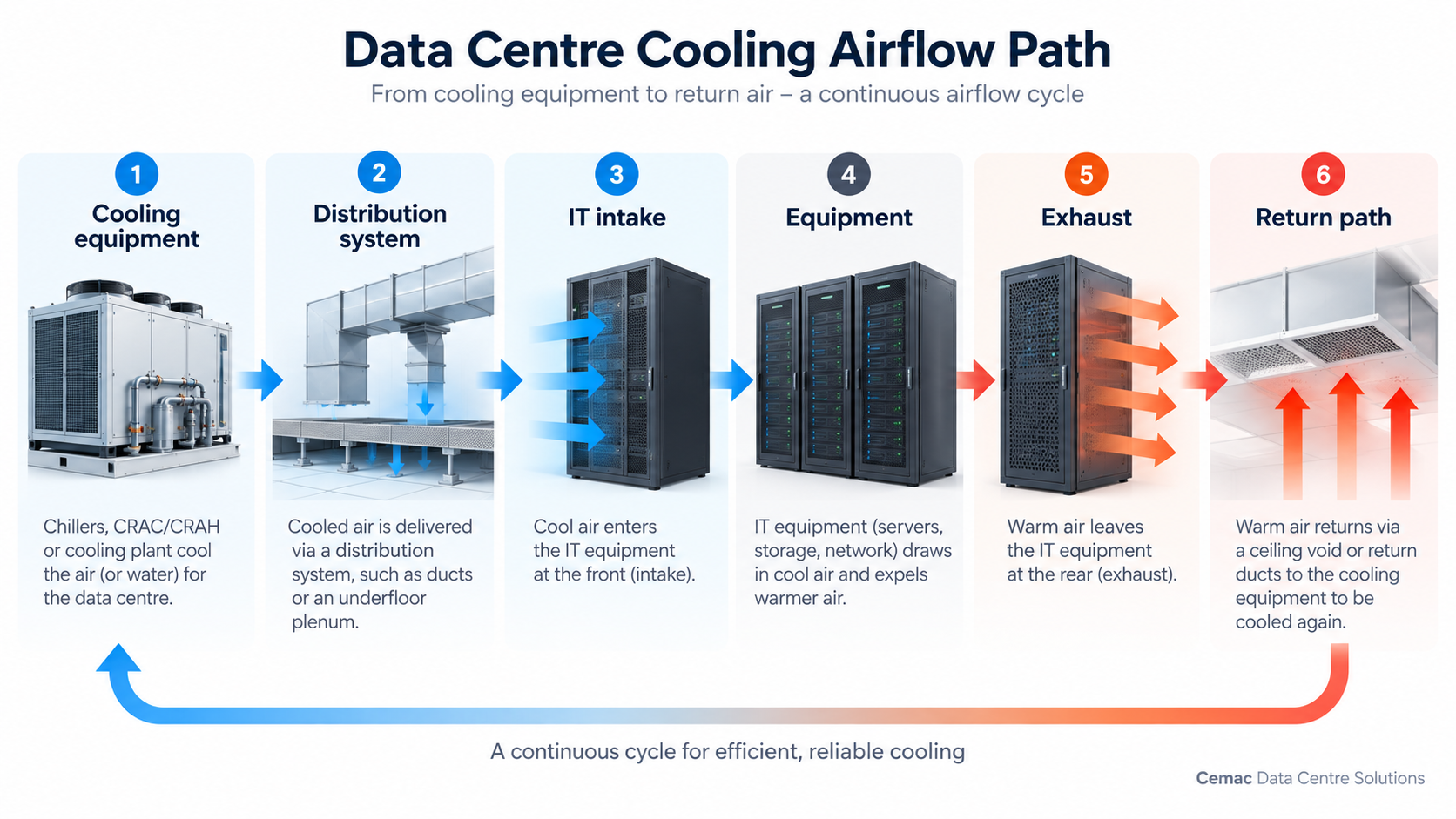
A weakness anywhere in that chain can reduce effective cooling.
Cemac’s raised access floor systems are used to organise services while maintaining access and flexibility for changing equipment requirements. When combined with the right airflow panels and controls, the floor can also become an important part of the cooling distribution strategy.
High-density racks make distribution more important
Average rack density can be misleading. Two data halls may both average 10 kW per rack, but one may contain relatively uniform loads while the other includes several much higher-density systems.
The average is the same. The airflow challenge is not.
A high-density rack needs substantially more heat removed from approximately the same physical footprint. That means more air must reach a smaller area, and the limiting factor may become the amount of airflow that can practically be delivered through a floor panel, aisle, rack face or duct system. This is becoming more important as AI and accelerated computing increase rack-level loads.
Cemac’s existing article on AI and data centre design reflects the same broader shift: higher-density compute is changing the physical infrastructure requirements of the data hall. In those environments, simply adding more room-level cooling may not solve a rack-level airflow constraint.
The goal is matched airflow, not maximum airflow
More airflow is not automatically better airflow. Data centre loads change over time. IT utilisation varies, racks are refreshed and different parts of the hall can operate at very different thermal loads.
The objective should therefore be to provide the amount of air required by the equipment, where it is required. Variable-speed and modular fan systems can help support that approach.
Tate’s Fan Wall Systems, for example, use modular fan arrays and variable-speed operation. Tate describes the systems as allowing airflow to be matched to demand while providing controlled support for hotspots and higher-density zones. This is also important from an energy perspective. Increasing fan speed can carry a significant power penalty. If the real issue is recirculation, bypass or excessive resistance, simply moving more air may increase energy use without fixing the root cause. The aim should be useful airflow, not maximum airflow.

Bringing cooling closer to the load
As rack densities rise, another question becomes increasingly important:
How far does conditioned air need to travel before reaching the equipment?
Traditional room-based cooling can require air to move through plenums, raised floors, ducts or large areas of open data hall before it reaches the rack. Every stage introduces opportunities for pressure loss, leakage and mixing.
One response is to bring air handling closer to the IT load. Tate’s HAC-Integrated Air Handling Units combine cooling and containment in a system intended for high-density, hybrid and pod-based data centre environments. Tate positions the approach around localised cooling and controlled airflow. The broader principle is simple: reducing the distance and complexity between the cooling source and the IT load can make thermal performance easier to control.
Airflow still matters in hybrid cooling environments
Liquid cooling is becoming increasingly important for high-density computing, but it does not necessarily remove the need for airflow management. Many facilities are likely to operate as hybrid environments. Processors or accelerators may be liquid cooled while networking equipment, storage, memory and other components still reject heat into the air.
Tate’s HAC literature specifically positions air and liquid cooling as systems that can operate within the same data hall. The underlying principle remains the same regardless of the cooling medium: the cooling has to reach the heat source. For air cooling, that means controlled airflow. For liquid cooling, it means the correct coolant flow, pressure and temperature.
Better airflow can unlock capacity that already exists
This is where airflow management becomes a capacity-planning issue. A data hall with significant bypass or recirculation can appear to require more mechanical cooling before the existing system has reached its useful limit. Improving containment, airflow pathways and distribution can allow more of the installed cooling capacity to perform useful work.
That can be particularly important in retrofit environments, where adding new plant may be expensive or disruptive. Airflow panels, containment, access flooring and air-handling systems should therefore not be considered in isolation. They form part of the same thermal system.
Cooling capacity creates potential. Airflow determines how much can be used.
Adequate cooling capacity will always be essential. No amount of airflow optimisation can compensate for a system that is fundamentally undersized.
But once sufficient capacity is in place, the challenge shifts from how much cooling is available to how effectively it is delivered. Poor airflow can create hotspots despite spare capacity, while recirculation, bypass and pressure imbalances can prevent conditioned air from reaching the racks that need it most. In higher-density environments, these localised cooling demands can also be masked by room-level averages.
For data centre operators, the key question is therefore not simply “How much cooling capacity do we have?”
but rather “How effectively is that cooling reaching the IT equipment?”
That is the distinction that matters. Cooling capacity sets the limit of what the system can remove; airflow determines how much of that capability is actually usable at the rack.
Airflow determines how much of that potential the data centre can actually use.
Cemac Data Centre Solutions delivers integrated infrastructure packages for data centre and technical environments, including airflow, containment and raised access floor solutions, and is a supplier of Tate solutions in New Zealand.
For new-build, retrofit or higher-density projects, designing airflow as part of the wider infrastructure strategy can help ensure the cooling capacity being installed is used where it matters most.
Talk to us about airflow, containment and integrated data centre infrastructure for your next project.